
Laatste update: 02/11/2026
The capacity tariff makes your electricity bill more expensive when many appliances are running at the same time. In a B&B or holiday home, this often happens between 5 PM and 8 PM: guests arrive, plug their car into the charging station, the sauna heats up, and the stove is turned on in the kitchen. Those who flatten that peak pay less. In our calculation example, smart control of just the charging station already yields about 340 euros per year, for an investment of at most a few hundred euros. A home battery rarely pays for itself on the capacity tariff alone; it only becomes interesting if your solar panels have a lot of surplus. And the climate? It wins too, but less than you often read.
How does the capacity tariff work?
Since 2023, you have been paying part of your network costs in Flanders via the capacity tariff. It applies to families and small businesses with a digital meter, so also to most B&Bs and holiday homes. This is how it works:
- Your digital meter calculates every fifteen minutes how much power you are drawing from the grid on average.
- The highest fifteen-minute period of the month is your monthly peak, expressed in kilowatts (kW).
- You pay based on the average of your monthly peaks over the past twelve months. A monthly peak below 2.5 kW counts as 2.5 kW.
In 2026, each kW of average monthly peak will cost approximately 52 to 61 euros per year (including 6% VAT), depending on your network area. In our calculation example, we use 57 euros: the average of the eight Flemish network areas.
Two things that are often misunderstood:
- You still pay per kWh. The capacity tariff only replaces part of the network costs. In addition, you still pay an offtake rate per kWh (in 2026 approximately 5 to 6.5 cents, excluding VAT) and the energy itself. Flattening peaks lowers the peak portion of your bill, not your consumption.
- One evening per month is enough. Only one fifteen-minute period per month counts. If everything coincides once, you pay for that peak, even if the rest of the month was quiet.
You can see your own monthly peaks for free in Mijn Fluvius or in EnergyID.
Why an accommodation peaks faster than a household
A family rarely turns everything on at once. In an accommodation, this does happen because guests have their own rhythm and often arrive around the same time. The largest power draws:
- Charging station: 11 kW is common with a three-phase connection.
- Sauna: a 6 kW heater is a common size (source: manufacturer Harvia).
- Hob and oven, boiler, heat pump, dryer: several kW each.
How high your peak can go also depends on your connection. With a single-phase 40-amp connection, for example, you are at a maximum of around 9 kW. An 11 kW charging station requires a three-phase connection.
Flattening those peaks is also called peak shaving: you “shave off” the highest peaks by not letting appliances run at the same time, or by having a battery jump in for a moment.
What does the capacity tariff cost in a B&B? A calculation example
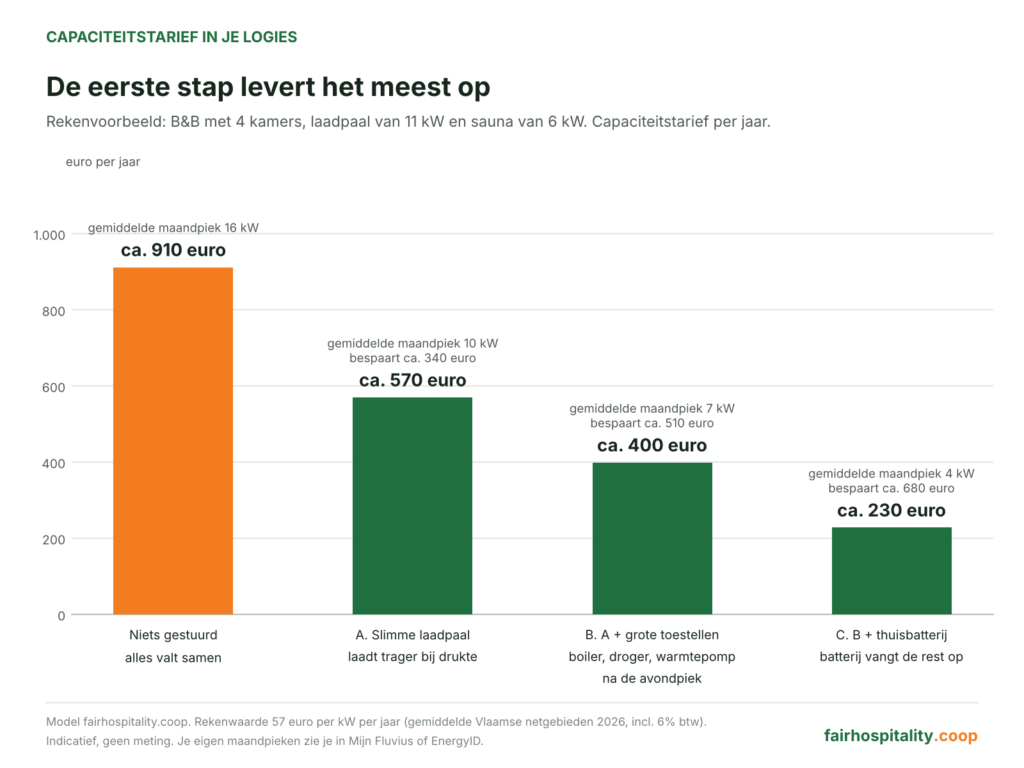
We take a B&B with four rooms, a three-phase connection, an 11 kW charging station for guests, and a 6 kW sauna. In 9 out of 12 months, there is at least one evening when a guest is charging while the sauna is heating up and cooking is taking place: a peak of 18 kW. In the three quietest months, it stays at 10 kW. This gives an average monthly peak of 16 kW.
| Scenario | What happens? | Average monthly peak | Capacity tariff per year | Savings per year |
|---|---|---|---|---|
| Nothing controlled | Everything coincides | 16 kW | approx. 910 euros | |
| A. Smart charging station | The charging station charges slower or pauses as soon as total consumption threatens to go above 10 kW | 10 kW | approx. 570 euros | approx. 340 euros |
| B. A + control of large appliances | Boiler, dryer, and heat pump wait until after the evening peak; the sauna starts up slightly earlier | 7 kW | approx. 400 euros | approx. 510 euros |
| C. B + home battery | A battery with about 5 kW discharge power absorbs the rest of the peak | 4 kW | approx. 230 euros | approx. 680 euros |
Calculation value: 57 euros per kW per year, including 6% VAT. This is a model, not a measurement.
What the table shows: the first step yields the most. The battery adds about 170 euros per year to your savings on the capacity tariff on top of scenario B.
Note: if your average monthly peak is already around 4 to 5 kW, there is little to be gained. So look at your own figures first before you buy anything.
For comparison: at ScraB&Ble, Jan’s B&B, the charging station charges slowly. There, the annual average fluctuates between 3.9 and 4.9 kW. You can read how that evolved after extra solar panels and with a malfunctioning charging station in the forum post Three years of monthly peaks in our B&B.
What does it cost to lower your peak, and when do you earn it back?
A. Smart control of the charging station
A charging station with dynamic load balancing reads how much you are consuming in the house via the user port (P1 port) of your digital meter, and adjusts its charging power accordingly. Many recent charging stations can already do this, sometimes with an extra module. You must first have the user port opened via Mijn Fluvius.
- Cost: from nothing (if your charging station can already do it) to about 300 to 800 euros for a module or control box with installation.
- Savings in our example: about 340 euros per year.
- Payback period: 1 to 2.5 years, or immediately if your charging station can already do it.
For your guest, this means the car charges slower. Those staying overnight usually have a full battery in the morning anyway. If a guest needs to charge quickly and a lot, refer them to a public charging station nearby. You can read more considerations in the forum post A charging station for your guests: smart now or wait a while?
B. Also control the large appliances
An electrician installs an energy management system (EMS) with switches (relays). This allows the electric boiler, heat pump, dryer, or dishwasher to run only after the evening peak.
- Cost: about 800 to 1,800 euros, including installation. This is an indication: request a quote.
- Savings in our example: about 510 euros per year.
- Payback period: about 2 to 3.5 years.
Two points of attention. Control around your guest, not the other way around: do not block the sauna or the spa at the moment a guest wants to use them, but let them heat up a bit earlier or let the charging station wait for a moment. And shift the boiler in time, not in temperature: hot water must remain at at least 60 °C against legionella. You can read more about this in our article on energy consumption in winter.
C. A home battery
- Cost: about 5,000 to 9,000 euros for a 10 kWh battery, installed and including VAT (2026 prices, indicative). Flanders no longer provides a subsidy for home batteries.
- VAT: 6% only under conditions, including a home at least ten years old that is used primarily privately, and installation by an installer. For a holiday home, 21% is more likely. Check with your accountant.
What does a battery yield?
- On the capacity tariff: on top of smart control, about 170 euros per year in our example. With that alone, you won’t earn back a battery.
- On your solar power: every kWh of solar surplus that you use yourself in the evening instead of putting it on the grid yields roughly 20 to 25 cents. You don’t buy that kWh (all-in about 31 cents), and you only miss a small injection fee (in 2026 often around 6 cents, differs per supplier). If about 2,000 kWh per year goes through your battery, that is about 400 to 500 euros.
- With a dynamic contract you can charge when electricity is cheap. How much that yields depends heavily on the prices. We don’t have a reliable figure for that.
A battery also loses about 10% of the energy during charging and discharging.
- Payback period: with solar panels and sufficient surplus roughly 8 to 15 years. Without solar panels, a lot longer. Compare that to the warranty, which is often 10 years.
In short: a battery can be useful if you already have solar panels with a lot of surplus. Don’t buy them for the capacity tariff alone.
What does peak flattening yield for the climate?
Honest answer: less than is often claimed, but it is not nothing.
Belgian electricity emitted an average of about 182 grams of CO₂ per kWh in 2025 (in CO₂ equivalent, according to Electricity Maps). This differs per hour: around noon the sun delivers, in the evening it doesn’t. In summer it is about 216 grams at 8 PM compared to 104 grams at 12 PM; in winter it is 232 grams at 6 PM compared to 189 grams at 12 PM.
If you shift your consumption from the evening to noon, that makes a difference of about 40 to 110 grams per kWh. Suppose you shift 3,000 kWh per year this way, especially charging sessions and hot water: then it is about 100 to 300 kg of CO₂ per year, after deducting the losses of any battery. You get the greatest climate benefit if your consumption coincides with the hours when your own solar panels are producing.
In addition, there is a benefit that you don’t see on your bill: if many connections flatten their peak, the grid needs to be expanded less quickly with new cables and substations. That is exactly why the capacity tariff exists.
What do you tell your guests?
- About the charging station: state in your welcome folder or booking confirmation that the car charges at a steady pace at night and is ready in the morning. This way you avoid surprises.
- About sustainability: say specifically what you do, for example: “Cars charge at a steady pace at night with us, and during the day we use as much solar power from our roof as possible.” Avoid words like “climate neutral” or “green B&B”. Since September 27, 2026, you are no longer allowed to use these just like that. Read how it can be done in No more “eco” without proof.
Start here: three steps
- Check your monthly peaks of the past year in Mijn Fluvius or EnergyID. Which months stand out, and what was running then?
- Ask your installer if your charging station can control dynamically on your digital meter. That is usually the cheapest win.
- Only then think about relays or a battery, and request two or three quotes based on your own consumption data.
Do you also want to monitor your consumption per guest per night? You can do that with the footprint module. More tips on solar power, heating, and hot water can be found on our page sustainable energy management for accommodations.
And you? How high is your average monthly peak, and what pushes it up? Do you already have a smart charging station or a home battery? Share your experience in the forum thread Home battery or elsewhere in the Sustainable Energy Management forum. This way we all learn faster.
For hosts, by hosts.
Sources
- Flemish Utility Regulator, network tariffs campaign: calculation of the capacity tariff (fifteen-minute peak, average of 12 monthly peaks, minimum 2.5 kW). PDF
- Ecopower, 2026 tariff card: capacity tariff and offtake rate per Fluvius network area. PDF
- Fluvius, Capacity tariff (for families and small businesses). Link
- Test Aankoop, Capacity tariff in Flanders (minimum 2.5 kW applies per month). Link
- City of Ghent, The capacity tariff: how does it work? (monitoring monthly peaks in Mijn Fluvius or EnergyID). Link
- Electricity Maps, Grid in review 2025: Belgium (average CO₂ intensity and difference per hour). Link
- Harvia, FAQ about the energy consumption of a sauna. Link
- Energiebewust Ontwerpen, Home battery 10 kWh: 2026 price (5,000 to 9,000 euros including VAT and installation). Link
- Bobex, VAT on a home battery (conditions for 6%). Link
- Selectra, Home batteries in Flanders 2026 (no more Flemish subsidy), September 28, 2026. Link
- CREG tariff first quarter 2026, Flanders: 0.3132 euros per kWh all-in. Link
- Eneco, Power Fix tariff card August 2026 (injection fee). PDF
- Callmepower, Home battery (efficiency about 90%, warranty often 10 years). Link
- Calculation example: own model from fairhospitality.coop, with the assumptions from this article.

