Laatste update: 08/08/2026
Fairhospitality.coop is a learning community of small-scale accommodation owners in Flanders working together on economic & ecological operation for lodging. For hosts, by hosts – we help you step by step to make your B&B, vacation home, guesthouse or hotel more sustainable, from energy management to eco-labeling to regenerative operation.
Hot topic: Many business owners are currently interested in their carbon footprint per person per night. Click here to calculate it for your business
Hospitality is already in you, you don’t have to learn it. What we can grow in is how to keep our business healthy in times of rising costs and taxes. How do you save on energy, water, food and drink in a way that is good for your wallet and your environment? By learning from each other, you’ll discover what can work for you, too. And those who want to prepare for certification will get support from hosts who have already walked that path. Finally, we like to inspire those who like to highlight their positive impact on the neighborhood.
Specifically, we like to help each other with next steps:
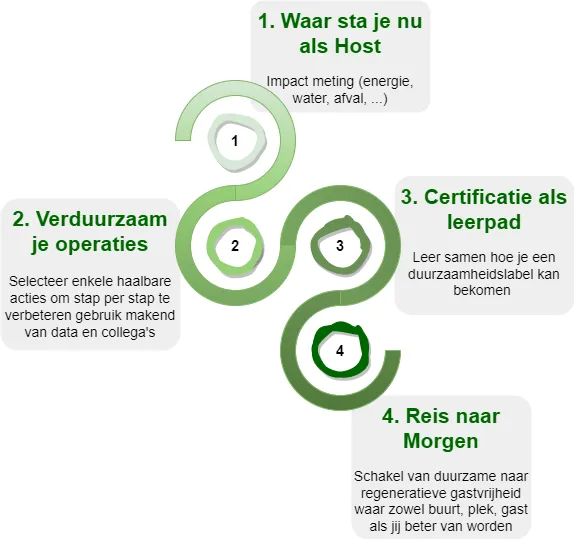
Here are the four steps you can follow with us. You can also feel free to follow only the steps that interest you.
1. Where do I stand now as a host?
The first step in your learning community is for each host to gain visibility into their own impact.
- Through host-specific sustainability assessments, you identify energy, water and waste streams.
- The results form the basis for the digital dashboard and for concrete improvement actions per accommodation.
2. Embed sustainability in my daily operation
The second step – making your operations more sustainable – aligns perfectly with easily learning and incorporating some concrete sustainable practices. We study numerous options that are better for the environment and wallet. We also look at impact to see what makes the most sense for you. After all, there is so much you can do, but you have limited time and budget.
- In the peer group, hosts work together on energy conservation, water reduction, less waste, etc.
- You use the shared data to positively “peer-push” each other toward better performance.
These actions make sustainability tangible and measurable, and lay the groundwork for both certification and regenerative steps in the environment.
3. Certification as an aid and preparation for EU legislation
Lodging providers get lost in the labels available. And many get stuck on the question: is it worth it? You decide for yourself, but you can already follow and learn here how to get certified. The step “show your efforts with certification” becomes very concrete in your project through the certification circle around the EU environmental label.
- Five hosts, including the initiators, are working together to achieve (or almost achieve) the EU Ecolabel.
- By sharing documentation, preparing each other for audits, and learning together, a tough course becomes achievable for micro-logies.
In this way, certification becomes a learning process and evidence of progress within the community, not just a label on the wall.
4. Journey to Tomorrow
Thinking and acting differently, with the neighborhood
In your project, hosts learn together how tourism can strengthen their village, natural area or neighborhood, rather than just mitigate damage. You consciously look for ways to connect to what is really important for the future of the area – such as water, nature, livability and local economy – in collaboration with partners and with the people of the neighborhood themselves.
Thus, “thinking differently about tourism” is made concrete in examples and partnerships that can inspire you.
This website is a living thing. By collaborating with colleagues and local partners and sharing experiences, we are building journeys to tomorrow together.
Collective intelligence, stronger than artificial intelligence !
Share your experiences, participate in discussions through our forums


