
Laatste update: 02/11/2026
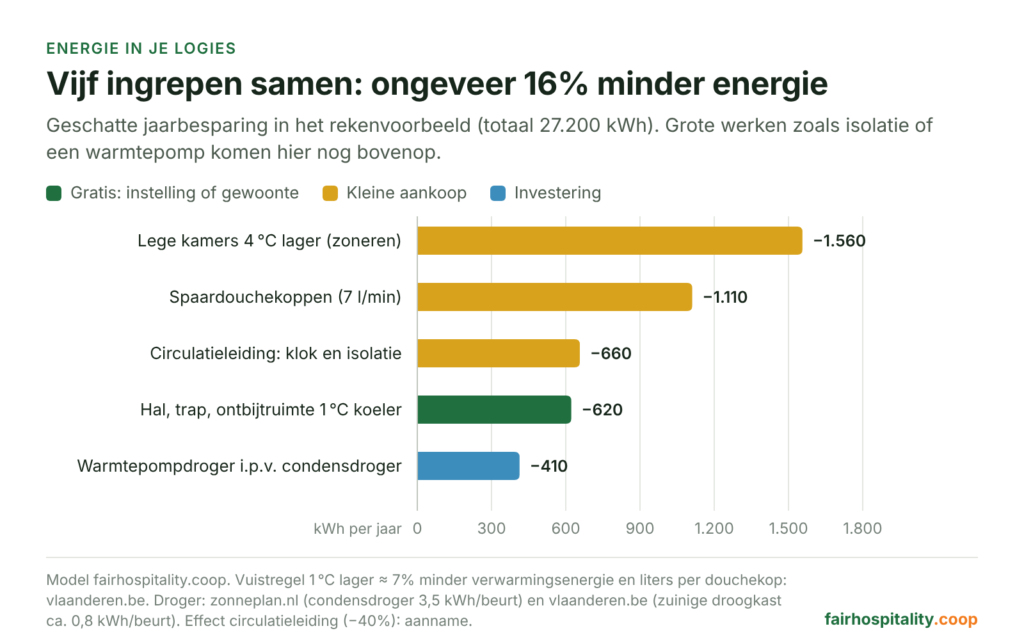
Energy consumption in winter is much higher in a B&B than in summer. In our calculation example of a four-room B&B, January requires 4.5 times as much energy as July. In winter, heating is by far the largest expense, but over the whole year, hot water carries more weight in a lodging than at home: nearly a quarter of the total. If you have a sauna or outdoor spa, you likely have another major consumer. The good news: with five simple interventions, you can reduce it by about 16% in our example, even before you start with insulation or a heat pump.
Below you can read why winter weighs so heavily, how heating and hot water relate to each other, which energy guzzlers you might be overlooking, and what you can still do this month.
Why energy consumption in winter is so high
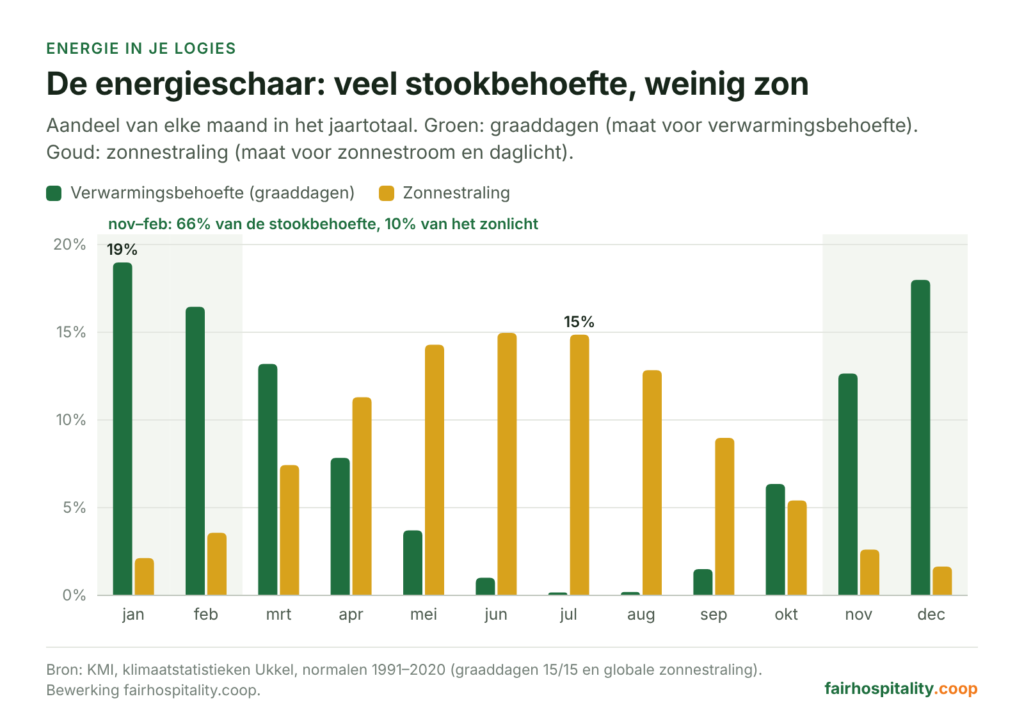
Heating needs are measured in degree days: the colder the day, the more degree days. According to the RMI (Uccle, average 1991–2020), January has 348 degree days while July has barely 3. The months of November through February together account for 66% of the annual heating requirement. Those same four months provide only 10% of the annual sunlight.
For energy consumption in winter, four additional effects come into play for an accommodation:
- Tap water is colder. Your boiler has to heat up more for the same shower.
- It stays dark longer. More lights are on, and your solar panels produce little. What you don’t generate yourself, you take from the grid.
- Laundry doesn’t dry outside. Everything goes through the dryer.
- Fewer guests, yet a warm house. Occupancy drops, but rooms, hallways, and the breakfast area must stay at temperature.
Month by month: a calculation example
To make it concrete, we calculated a typical Flemish B&B: four guest rooms with private bathrooms, a breakfast area, totaling about 150 m², heated with a gas boiler. On average, the B&B is half occupied (25% in January, 80% in August), with 1.9 guests per room. That results in about 1,440 guest nights per year.
This B&B consumes about 27,200 kWh per year. Energy consumption in winter weighs heavily: October through March account for 72% of the annual total.
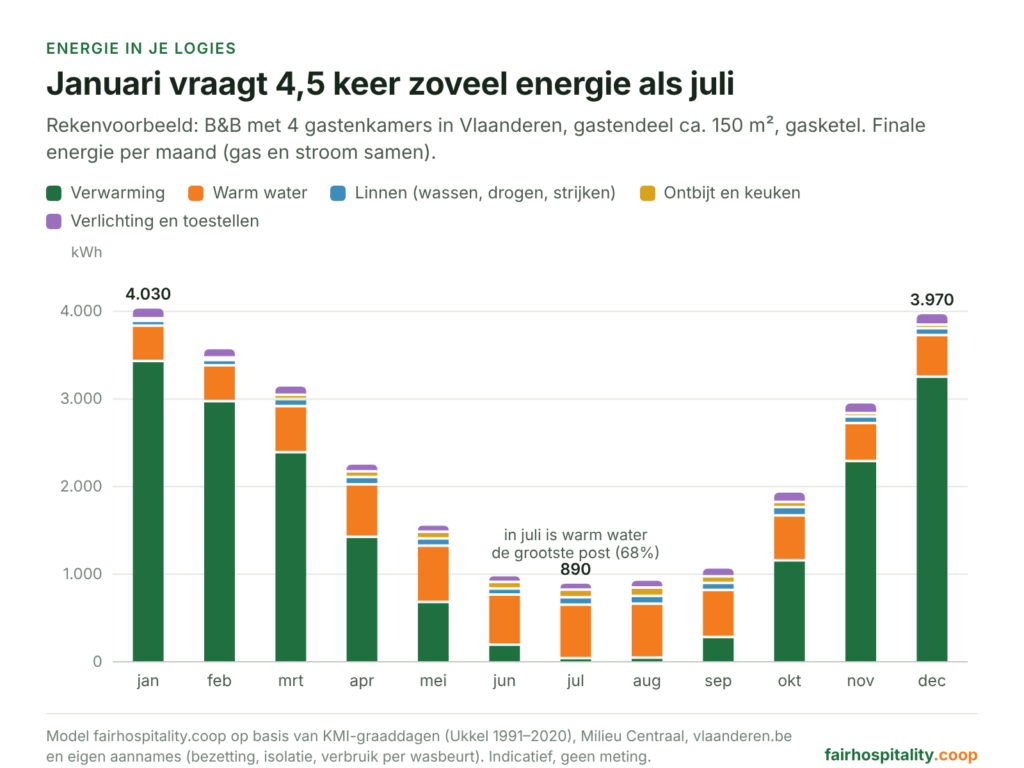
Note: this is a model, not a measurement. Your own figures depend heavily on your building, your installation, and your occupancy. Further down, you can read how to create your own seasonal curve.
Heating or hot water: which weighs the most?
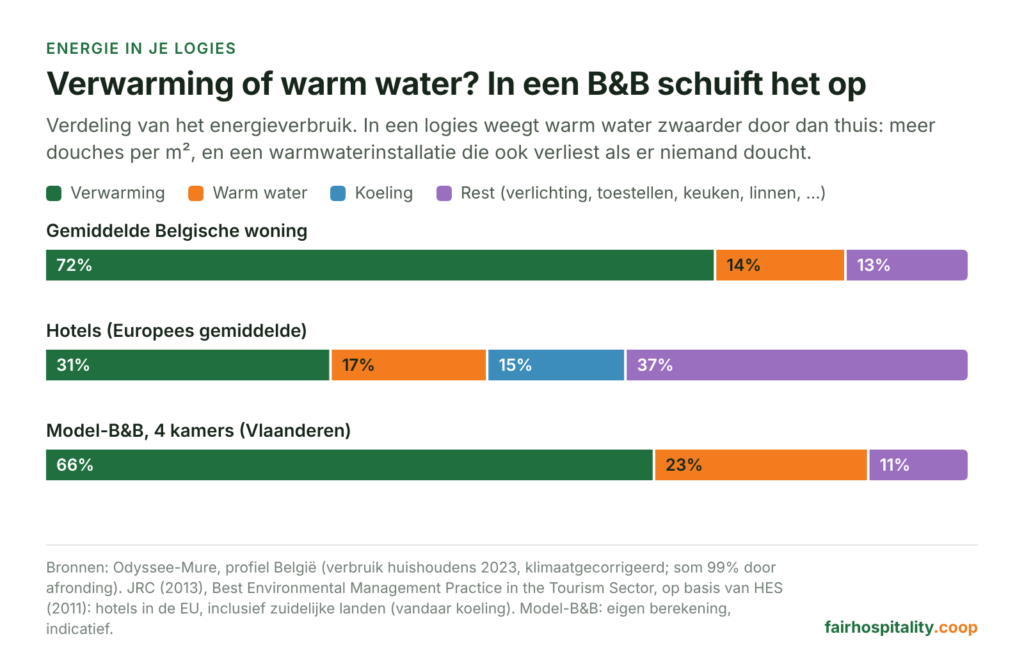
Over the whole year, heating is the largest item: 66% in our example, compared to 23% for hot water. For every kWh of hot water, nearly 3 kWh goes to heating. But that ratio shifts significantly with the seasons:
- In January, 85% goes to heating and 10% to hot water.
- In July, it reverses: hot water is then the largest item, with 68% of consumption.
Compared to a regular home, hot water in a B&B clearly weighs more. In an average Belgian home, 72% goes to heating and 14% to hot water (Odyssee-Mure, 2023 figures). In European hotels, hot water accounts for 17%.
Why hot water weighs so much in an accommodation: every guest showers, often longer than at home, and more people sleep per square meter. A rain shower consumes up to 125 liters per five minutes, a water-saving showerhead 35 liters (vlaanderen.be). And in winter, the same shower costs over half as much energy because the water enters colder.
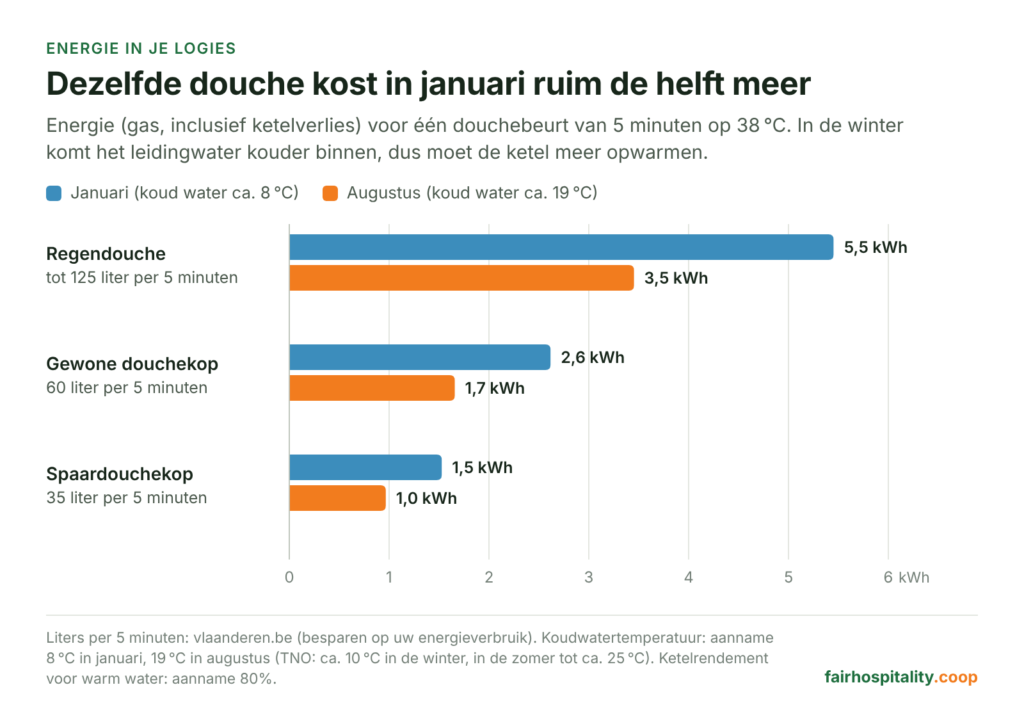
Do NOT turn down your boiler to save money. Legionella can grow below 60 °C. The Flemish government (Care and Health) recommends keeping your boiler at at least 60 °C. Accommodations that can host 15 or more people also fall under the Flemish Legionella Decree. So save on hot water through fewer liters and less loss, not through the temperature.
And cooling in the summer?
Summers are getting warmer and air conditioning is on the rise: in Belgian homes, consumption for air conditioning has more than doubled since 2010, although it starts from nearly zero (Odyssee-Mure). Yet for now, cooling in Flanders weighs lightly compared to heating. Eurostat counts an average of about 14 cooling degree days per year for Belgium (1979–2024), with a peak of about 53. The RMI counts 1,835 heating degree days per year in Uccle. The calculation methods differ, but the difference remains over a factor of one hundred. The 15% cooling for hotels in the graph above is a European average, including the warm southern countries.
A rough estimate for our example B&B: four fixed air conditioners running for about 25 warm nights together consume a few hundred kWh per year. That is a few percent of what heating costs. Two notes. Cooling happens with electricity and only partially coincides with your solar panels: guests cool mainly in the evening and at night. And anyone who installs a fixed air conditioner actually has an air-to-air heat pump that can also heat during the shoulder seasons. What helps most against heat is keeping the warmth out: outdoor sun protection, nighttime ventilation, and roof insulation. We will write more about that next spring.
The energy guzzlers you don’t see
Heating and hot water appear together on one gas bill. What you don’t see is how that bill is built up. In our calculation example, three items stand out.
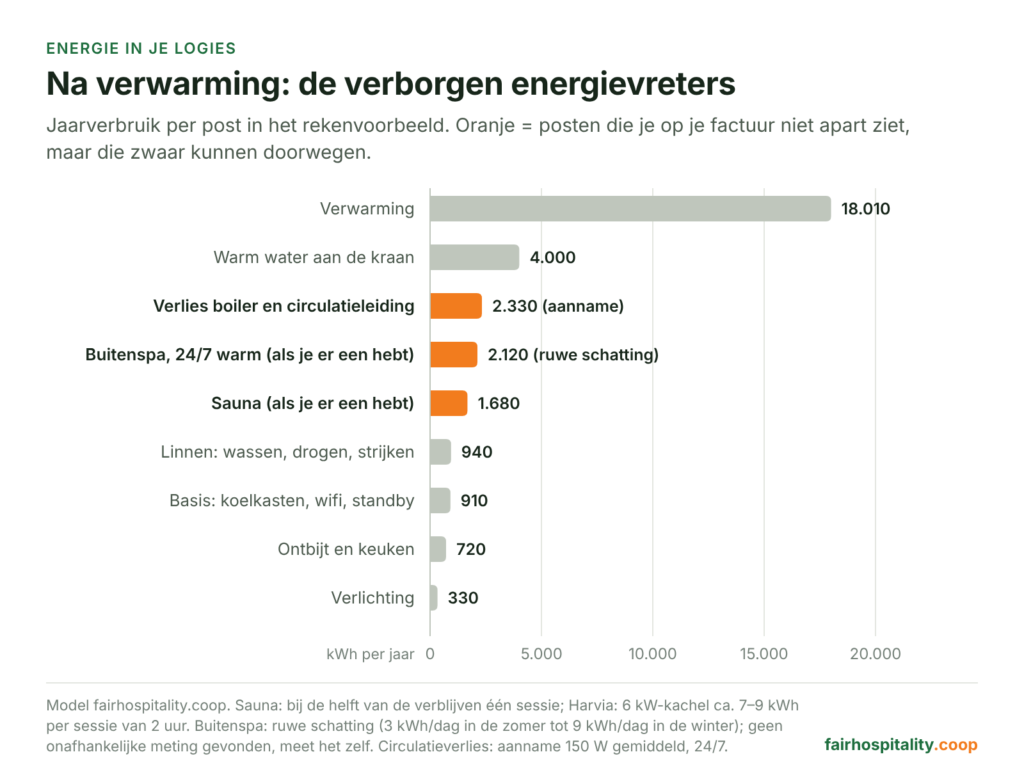
1. Loss from boiler and circulation pipe. Many B&Bs have a circulation pipe: a pump that circulates hot water day and night so that hot water comes out of the tap immediately. Convenient for your guests, but that pipe loses heat 24 hours a day, even in an empty B&B. In our example, more than a third of the energy for hot water is spent on losses. That is an estimate; measuring is the only way to know for your accommodation.
2. Wellness. A sauna with a 6 kW heater consumes about 7 to 9 kWh per two-hour session, according to manufacturer Harvia. An outdoor spa that stays at temperature day and night consumes the most in winter. In our example, the sauna and spa together consume more electricity than linen, breakfast, lighting, and all appliances combined. We found no independent measurement for the spa, so consider that figure a rough estimate.
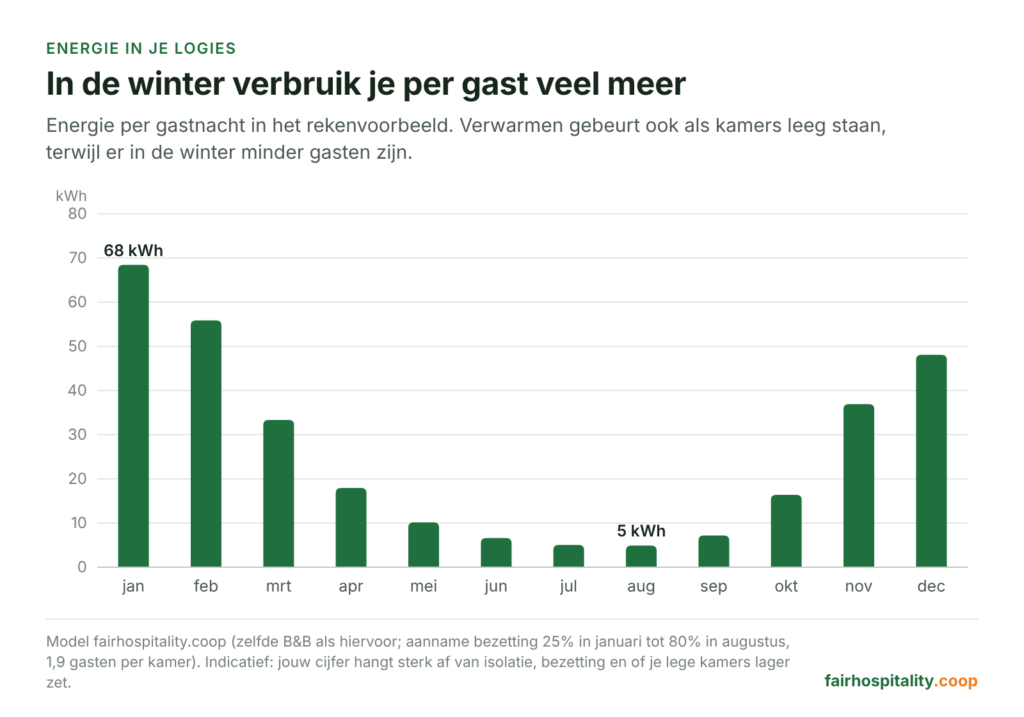
3. Empty rooms. Heating also happens when no one is sleeping. As a result, consumption per guest rises sharply in winter: in our example, about 68 kWh per guest night in January, compared to 5 kWh in August.
And the linen? With an average stay of less than two nights in hotels and guest rooms (Statistics Flanders, 2025), you change sheets often. In kWh, linen is a small item (about 940 kWh per year), but it is electricity, and in winter the dryer runs for every load.
Reducing energy consumption in winter: what can you do?
You cannot remove the seasonal effect itself: it gets colder, period. What you can do is flatten your energy consumption in winter. We list the interventions from free to investment.
This week, for free
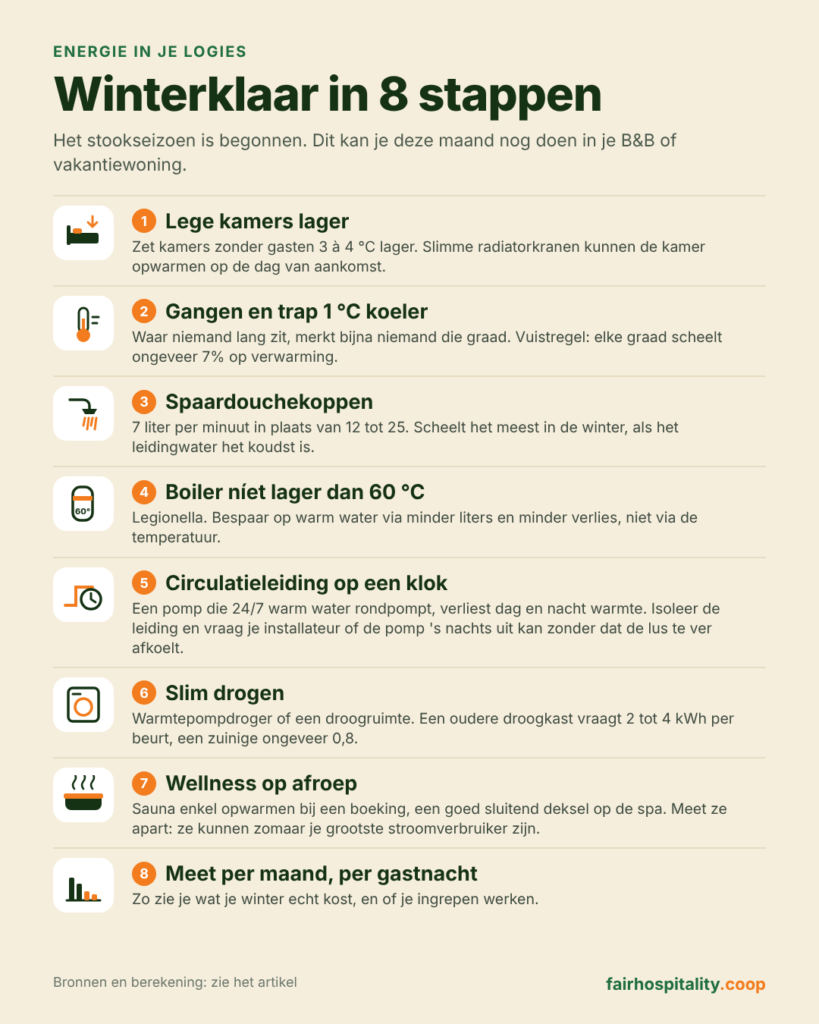
- Empty rooms lower. Set rooms without guests 3 to 4 °C lower. Don’t turn them off completely: a cold room is hard to warm up quickly, and moisture has more of a chance.
- Hallways, stairs, and breakfast area a degree cooler outside the times someone is there. Rule of thumb from the Flemish government: every degree lower saves about 7% on heating.
- Night setback if your heating is currently set to the same temperature day and night. According to vlaanderen.be, this yields about 10%.
- Ask about the flow temperature during maintenance. Is your boiler still on the factory setting? A lower flow temperature for your radiators gives higher efficiency, especially with a condensing boiler or heat pump. According to vlaanderen.be, a return temperature of 40 instead of 60 °C saves about 6%. Note: this is about the water in your heating system, not your domestic hot water. That stays at at least 60 °C.
- Bleed your radiators. Ten minutes of work. A radiator with air in it gives off less heat, while your boiler just keeps running.
- Wellness on demand. Only heat the sauna if there is a booking, and always put the cover on the spa.
- Spread out heavy appliances. Don’t use the dryer, sauna, heat pump, or charging station at the same time: your capacity tariff is calculated based on your highest quarterly peak per month.
Small purchases
- Smart radiator valves per room, so an empty room is automatically set lower and warms up in time for arrival.
- Water-saving showerheads of about 7 liters per minute. Definitely replace a rain shower. Test it in one room first and ask your guests what they think. Don’t know how much your shower gives? Hold a bucket under it and measure with your phone how many liters come out in one minute. That it pays off is shown by the Maltese GUEST project: 28 guest houses together saved nearly 22,000 kWh by addressing excessive water flow rates.
- Insulate boiler and pipes. According to vlaanderen.be, this saves about 10% on heating water. Ask your installer if the circulation pump can be turned off at night without the pipe cooling down too much.
- Radiator foil behind radiators against an uninsulated outer wall (about 2%) and draft strips (about 1%).
Investing
- Insulation of the roof, walls, and windows tackles the winter peak at the source.
- Heat pump or heat pump boiler. According to vlaanderen.be, a heat pump boiler is 3 to 4 times more efficient than a regular electric boiler. Note: a heat pump shifts your winter peak from gas to electricity, just when your solar panels produce the least.
- Solar boiler: can cover about half of your hot water, especially outside of winter.
- Efficient heat pump dryer: vlaanderen.be calculates about 0.8 kWh per cycle for an efficient A-label dryer, compared to 2 to 4 kWh for an older one.
Tourism Flanders had an accommodation subsidy in 2026 focusing on energy saving (40%, up to 100,000 euros per recognized accommodation). That call ran from June 1 to September 21, 2026, and has therefore ended. Keep an eye on the page for a next call. In the forum, you can read how two subsidy streams for a B&B can go together.
Measure your own seasonal curve
Our calculation example shows the pattern of energy consumption in winter. Your accommodation may look very different: better insulated, with a heat pump, with or without your own home under the same roof. Therefore: record your meter readings and your number of guest nights every month. With the footprint module, this happens automatically via EnergyID, and you get your consumption per person per night. Compare January with January of last year, not January with July. That way you can see if your interventions are working.
Start today. Record your meter readings now, at the start of the heating season. In April, you will know exactly what this winter cost, and you will have a figure to compare with next year.
More tips on heating, hot water, and solar power can be found on our page sustainable energy management for accommodations.
Scrabble B&B Example
In Scrabble B&B, we also see the summer/winter effect clearly. And not just in terms of heating. Some observations:
- Because our house was built according to passive house standards, we prefer a very cold but sunny winter day over a gray, half-cold, drizzly day. Why? On such a beautiful winter day, our house warms up very quickly due to the sunbeams entering our windows. Those windows were specifically chosen to let in as much of that heat as possible. And of course, our solar boiler and our PV panels also enjoy the sunshine.
- In winter, our transport becomes a lot more expensive: we don’t have enough solar energy then to charge our car. We do make sure to charge it slowly, which saves a lot on our capacity tariff.
- Occupancy in our rural B&B is much lower in winter. On days when it’s not rented out, we put the B&B in sleep mode: heating is set to winter mode and all standby consumption is switched off.
And you? How much does your accommodation consume in January compared to July? And which intervention yielded the most for you? Share it in the Sustainable Energy Management forum. That way we all learn faster.
For hosts, by hosts.
Sources
- RMI, climate statistics of Belgian municipalities, Uccle (normals 1991–2020): degree days 15/15 and global solar radiation per month. PDF
- Odyssee-Mure, Energy efficiency trends and policies, Belgium profile: distribution of household energy consumption 2023. Link
- JRC (2013), Best Environmental Management Practice in the Tourism Sector, with figures from HES (2011), as cited in the technical report for the EU Ecolabel for tourist accommodation. Link
- Flemish government, Saving on your energy consumption. Link
- Care and Health Agency, folder on legionella (2017): boiler at at least 60 °C. Link
- Department of Care, Legionella in sanitary installations. Link
- Visit Limburg, Guidance document for future starters of an accommodation: lodging from 15 people = moderate risk. Link
- Statistics Flanders, Overnight stays by stayover tourists (2025). Link
- Harvia, FAQ on the energy consumption of a sauna. Link
- Tourism Flanders, Accommodation subsidy. Link
- Eurostat, Cooling and heating degree days by country (nrg_chdd_a), via DBnomics. Link Explanation and EU trend: Eurostat Statistics Explained

