Laatste update: 09/06/2026
When we talk about sustainable hospitality, we cannot ignore the guest’s journey. At various moments, the traveler makes crucial decisions in the context of sustainability. Especially when we look further into its more impactful, regenerative variant.
We like to break down the customer journey into 5 steps
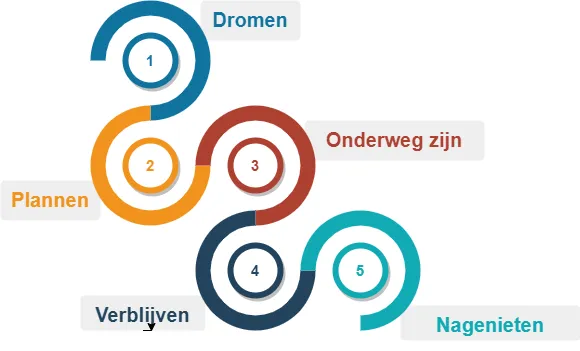
Those 5 steps are sometimes nicely in order, but in many cases they are not. Sometimes one dreams of the first part and leaves the next part of the journey open to inspiration of the moment. Sometimes one does a trek and is on the road, in the abode, back on the road, in another abode etc …. And sometimes we are already enjoying during the journey itself. Yet they are 5 essential components of a virtuous journey.
How can we as lodging operators have an impact in those 5 steps? How can we get the traveler to make the most sustainable choices?
Dreams
This is where the foundations are laid for the ultimate impact of the trip. More than half of travelers realize that they have an impact on local communities as well as the environment. But dreams are influenced by media, friends, internet, AI, etc.
What can accommodation operators do to make potential travelers dream of sustainable travel, slow travel, … ?
Discuss with us here.
Plans
The main focus of planning is booking. Booking is a crucial step in a sustainable journey.
- Do we book through a multi-national and thus let money escape to other places?
- Do we highlight sustainability or are we better off not doing so?
- Are we using alternative channels for bookings?
Discuss with us here
On the road
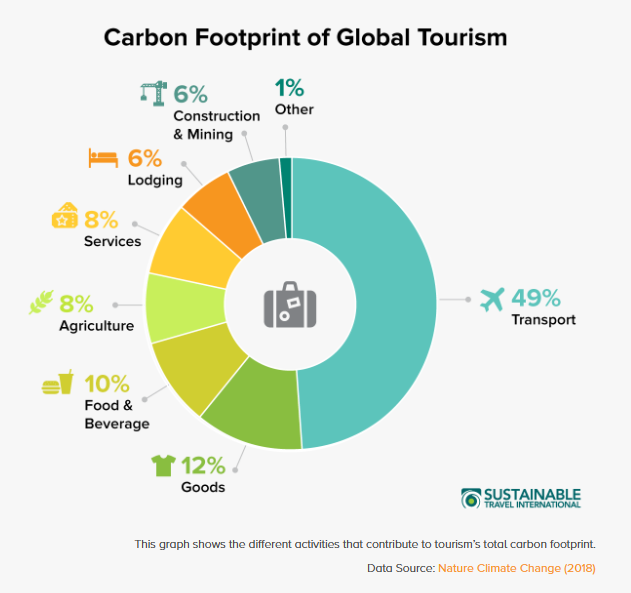
Transportation is and will continue to have the greatest impact relative to the other elements of tourism. We can influence that as lodgers with good communication and by offering facilities for the “last mile.
Discuss with us here.
Stays
The “stay” phase is where the physical interaction between guest, accommodation and environment reaches its peak. This is where we as accommodation operators have the most direct control over operational impact. Automation of sustainable measures is almost always more successful than trying to implement behavioral change in guests. But this only has a local impact, namely for the lodging itself. Trying to influence and motivate guests to change behavior both in the lodging and at home and elsewhere can have a very big impact, even bigger than what you can realize yourself in your lodging.
We are also talking about the so-called scope 4 here.
Discuss with us here.
Afterglow
Regenerative hospitality thrives on creating a community or ecosystem. When guests feel connected to the mission of the lodging and its environment, they become ambassadors who share their experiences. This can be facilitated by digital platforms where guests can reminisce about their experiences, share photos or participate in discussions about sustainability. Building such relationships increases loyalty and creates a sense of shared responsibility for the destination.
Discuss with us here.
The traveler’s outlook is evolving. By working with local partners and sharing experiences, we can constantly adapt our insights to reality.
Collective intelligence, stronger than artificial intelligence !
Share your experiences, join discussions through ourforums:
Dreaming, planning, on the road, staying, reminiscing


